


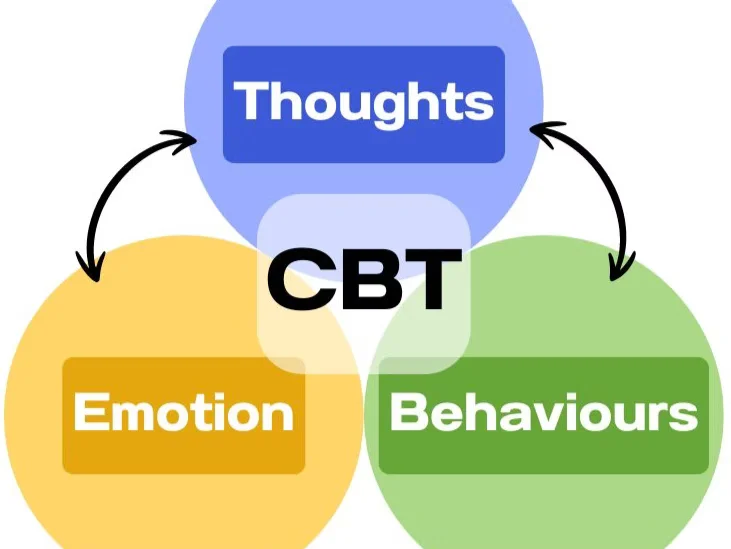
TLDR: CBT (Cognitive Behavioural Therapy) is a structured, evidence-based talking therapy that looks at how your thoughts, feelings and behaviours are connected, and gives you practical tools to change unhelpful patterns. Below, Ryan Hegarty, BABCP-accredited CBT therapist at Slán Therapy, breaks down what CBT therapy actually involves, what it treats, and what a session looks like in practice.
What is CBT therapy?
CBT is a structured, evidence-based talking therapy. It works from a simple premise: your thoughts, emotions, behaviours and physical sensations are all connected, and unhelpful patterns in one area tend to reinforce the others. Cognitive behavioural therapy is goal-oriented and focused on the present. Less “tell me about your childhood,” more “let’s work out what’s keeping this going and change it.”
I’m Ryan Hegarty, a BABCP-accredited CBT therapist based in Essex, offering private CBT therapy in person, online and via home visit. Here’s how it actually works in practice.
Why is CBT so widely used?
CBT became the NHS’s go-to treatment for anxiety and depression after 2005, when psychological therapies were made more widely accessible. There are three reasons it’s stuck around:
- It works. It’s backed by a substantial evidence base and shows effectiveness across a broad range of difficulties, from anxiety to chronic pain.
- It’s flexible. Delivered face-to-face, online, or via home visit, with equal effectiveness.
- It’s fast, comparatively. As a short-term, focused therapy, meaningful change is often possible in a relatively short number of sessions.
CBT therapy techniques: a real example
Say you’re anxious about parallel parking. Before tackling the anxiety, we need to understand what’s keeping it going. This is one of the core CBT therapy techniques: mapping a moment when the anxiety peaked. The thought running through your head, the emotion, how you behaved, and what you felt physically. It tends to look like this:
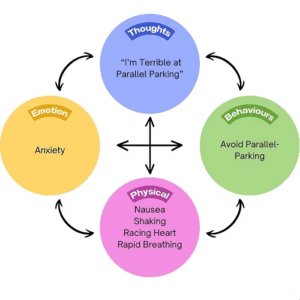
That avoidance feels sensible. But it’s also what keeps the anxiety alive. You never get the chance to test whether the belief is actually true. The thought and the anxiety just keep feeding each other.
If you park anyway, despite the anxiety and the thought, you might discover you’re better at it than you assumed, or that it wasn’t as bad as expected. Congratulations, you’ve just CBT’d yourself.
It’s a small example, but the same mechanism applies to bigger, more entrenched beliefs about yourself or other people. The kind that tend to sit underneath most mental health difficulties, including anxiety, depression, and CBT for anxiety specifically is one of the most researched applications of this approach.
What can CBT help with?
CBT has a strong evidence base for a wide range of conditions, including:
- Anxiety disorders
- Depression
- Insomnia
- Obsessive-compulsive disorder (OCD)
- Post-traumatic stress disorder (PTSD)
It’s also been shown to help manage symptoms of:
- Chronic fatigue syndrome (CFS)
- Irritable bowel syndrome (IBS)
- Fibromyalgia
- Tinnitus
- Chronic pain
One of the main benefits of CBT therapy is how directly it targets the specific problem you’re dealing with, rather than a general conversation about how things are going.
What happens in a CBT session?
Early sessions are about understanding why you’re there and setting clear goals for what you want out of the process. This usually starts with an assessment: when the difficulty shows up, what tends to trigger it, and the impact it’s having on your day-to-day life. From there, we build what’s called a formulation, a shared understanding of what’s keeping the problem going (similar to the parking example above, but tailored to you).
From that point, sessions move into active work. This might include:
- Identifying unhelpful thought patterns and testing whether they hold up against real evidence
- Behavioural experiments, deliberately doing the thing you’d normally avoid, to gather proof against the belief keeping you stuck
- Structured techniques specific to the difficulty you’re working on, whether that’s anxiety, low mood, intrusive thoughts, or something else
- Between-session tasks, such as tracking thoughts, monitoring behaviours, or practising a technique in real situations before the next session
That last point matters. CBT isn’t a therapy you sit back for. The work between sessions is often where the actual change happens, not just the fifty minutes in the room. Each session typically reviews what came up, adjusts the approach if something isn’t landing, and builds on progress from the last one.
If you want a clearer picture of what this looks like week to week, find out more about how sessions work or book a free discovery call to talk it through directly.
Will CBT work for me?
No therapy works for everyone in exactly the same way. Paracetamol sorts one person’s headache and does nothing for the next, who needs ibuprofen instead. What the evidence does show is that CBT helps the majority of people with the difficulties listed above, and plenty of others besides.
Is CBT right for you?
CBT won’t be the right fit for everyone, and that’s fine. But if you recognise yourself in any of the difficulties above, or you’re simply looking for a structured, evidence-based way to work through what’s going on, it’s one of the most researched and widely used approaches available for a reason.
What you get from it isn’t just relief in the moment. It’s a framework you keep using long after sessions end, one you can apply yourself the next time something similar comes up.
If that sounds like what you’re after, book a free discovery call and we’ll talk through whether CBT is the right starting point for you.