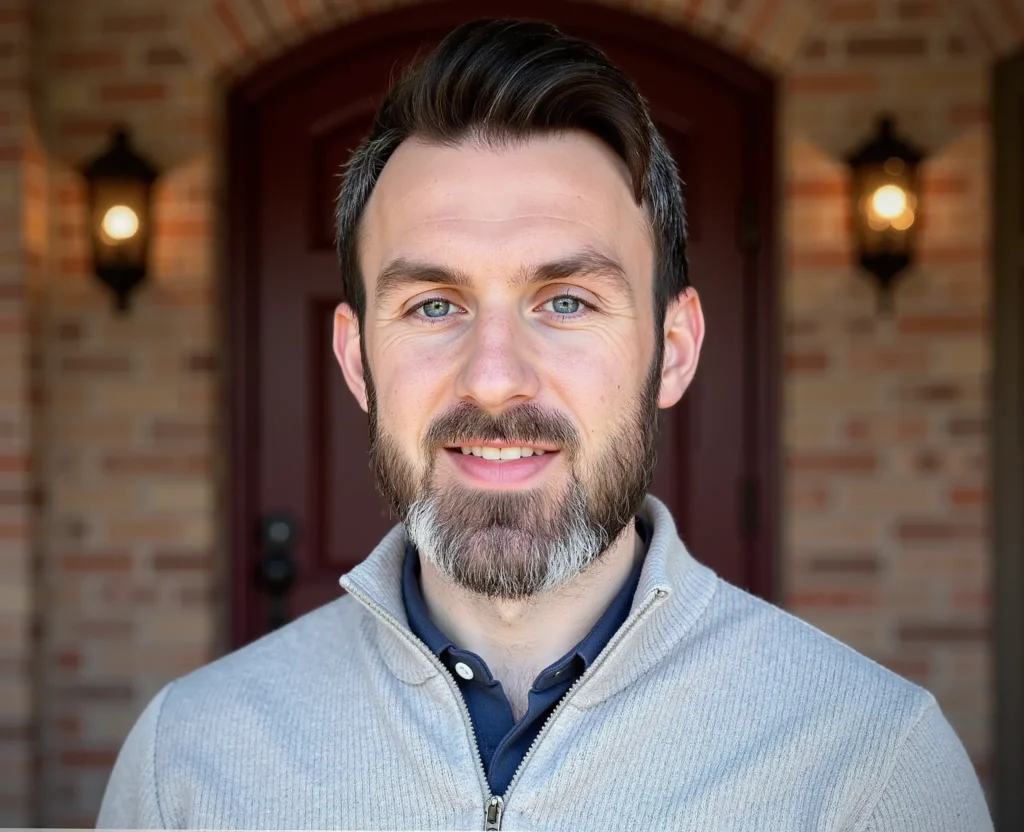





Meet Ryan Hegarty, a male therapist based in Essex
A therapist’s qualifications are important. But so is the person you’re working with. I hope this gives you a sense of what that’s like with me.


I didn’t take the standard private therapy path
Over a decade ago, I trained as a mental health nurse in Ireland. My first post after qualifying was at Broadmoor Hospital. From there, I moved to medium-secure services as a mental health nurse, then into primary care, which meant seeing mental health at every level of intensity.
Later, CBT appealed to me. Partly because it meant getting funding to train and not get punched in the face, which seemed like a win.
CBT & EMDR changed what I thought therapy could do
That CBT training changed the direction of my work, and led to me becoming a BABCP-accredited therapist.
CBT grabbed me because change became visible. You could see someone shift their thinking, sometimes there and then, and the room would change. It was immediate in a way much of my earlier work had not been.
I later became an EMDR practitioner for the same reason. It’s a more systematic method that gives the problem shape, then does something with it.
Now a private psychotherapist for clients across London and Essex
Now I’m based in Essex, working as a private psychotherapist while also holding a mental health adviser role at the University of Cambridge.
Alongside private practice, I’m currently doing a master’s in psychology, mostly because I appear to enjoy the torture of academia. There are easier hobbies, apparently, though with a wife and three children (including twins), I’m not sure when I’d do them anyway.
Who I work with, and what we work on
The people I work with tend to be business owners, senior leaders, public figures, and high-achieving professionals.
I work across Essex, Brentwood, Chelmsford and London, online or by home visit, often on issues like:
- Anxiety
- Burnout
- Trauma
- Depression
- Perfectionism
- Imposter Syndrome
- OCD
- Work-Related Stress
Book a call below, and we can work out whether I’m the right fit for you.
What guides my approach to therapy
A few things I believe in.
Problems Need Engineering
We make the problem explicit, look at the variables, and work out what can change.
Not Just for a Crisis
For many clients, therapy isn’t for rock bottom. It’s a serious investment in how you think, lead, and live.
Tools Should Outlast Me
A good outcome isn’t you becoming brilliant at therapy, but using what you learn when I’m not there.
Evidence-Backed Methods Only
A nice chat won’t get you anywhere. Action-based methods like CBT and EMDR will.
No Woo Woo Nonsense
If it sounds deep but changes nothing, I’m suspicious. The method needs to hold up outside the room.
Therapy Shouldn’t Feel Grim
Therapy can involve hard conversations and still have room for humour. You might even enjoy yourself. Shocking, I know.
The results, in their words
Without me doing the awkward “I’m brilliant” bit.
Can’t recommend highly enough!!!
Ryan was an exceptional trauma-informed CBT therapist and I can’t recommend him highly enough. From the very first session, he immediately made me feel relaxed, safe, and comfortable enough to open up about what was going on. He explained things in a way that was easy to understand and always made the techniques feel relevant and personal to my situation.
My time working with Ryan was very helpful and productive. I’ve had several counsellors over the years, and elements of Ryan’s approach were quite different and very suited to me. His manner is relaxed and empathetic. Whilst the time was taken to aid my understanding of myself, he also provided real tools and tactics that enabled me to put the changes I wanted to make into practice. This has often been the gap in the past that prevented me from making meaningful change. I’m doing well now, but wouldn’t hesitate to go back to Ryan, for a top up, or to work through another issue on the future. Thank you, Ryan.
Life Changing.
Ryan has been incredible throughout. His pragmatic approach and tools have helped me overcome a number of challenges which have built up over time.
His clear communication style and clarity ensured I was able to understand everything in the first instance and the awareness I developed with his help has significantly improved my view on many things and helped me be more accepting in certain situations which would have previously snow balled and got out of control.
Without question or doubt, I’d highly recommend Ryan. Thank you Ryan.
I couldn’t recommend Ryan more.
Ryan is a highly trained therapist, who you feel at ease with after just your first meeting. He speaks to you like you’re a real person and creates an environment that you feel that you can open up in. Ryan has real life applicable techniques which are easy to integrate into your day to day life. He genuinely has changed my life and way of thinking.

I have tried NHS and a few other therapy services. Slan Therapy was the one that stuck. Ryan is patient and lets you go at your own pace whilst also making sure you are progressing. He made me feel so at ease and I looked forward to the sessions instead of dreading them (like all the ones before). My life is now brighter since working with him. 100% recommend, his Irish self won’t let you down!

Ryan is a phenomenal practitioner of pyschotherapy and CBT. I started working with him on a personal recommendation and within a few sessions he had helped me not only understand (for the first time) what was going on for me, but also started equipping me with practical work that made a real difference.

Ryan is a highly trained therapist, who you feel at ease with after just your first meeting. He speaks to you like you’re a real person and creates an environment that you feel that you can open up in. Ryan has real life applicable techniques which are easy to integrate into your day to day life. He genuinely has changed my life and way of thinking.


Read more of our trusted reviews online
Therapies I specialise in
These are the main evidence-backed approaches I use in private therapy.
Cognitive Behavioural Therapy (CBT)
- Good for anxiety, stress, burnout, panic, and perfectionism.
- Helps us spot the loop you keep getting stuck in.
- Looks at thoughts, behaviour, emotions and body responses.
- Makes vague problems easier to work with.
- Gives you tools to practise outside the session.
Eye Movement Desensitisation and Reprocessing Therapy (EMDR)
- Good for trauma, triggers, and difficult memories.
- Helps process material that still feels too active.
- Useful when your head knows it’s over, but your nervous system doesn’t.
- Reduces the emotional charge around old experiences.
- Helps when talking alone hasn’t shifted things.
Compassion-Focused Therapy
- Good for shame, guilt, imposter syndrome, and self-criticism.
- Helps when your own mind is a fairly hostile workplace.
- Looks at threat, drive, and soothing systems.
- Builds a less brutal internal voice.
- Useful for high-functioning people running on pressure.
What happens on the discovery call?
We talk. You tell me what has brought you here, as best you can. I’ll ask a few questions, explain how I work and give you a sense of whether I think I can help.
You’re under absolutely no obligation to go ahead. In fact, I’ll tell you straight if I’m not the right therapist for you. Book your discovery call now if you’re ready to get started.
What if I’ve tried therapy before and it didn’t help?
That’s definitely worth talking about. I’d want to know what felt useful, what felt useless, and what you were left needing.
Sometimes therapy fails because the fit was wrong, the method was wrong, or the work never became concrete enough.
I’m not sure my problem is serious enough for therapy. Is that normal?
Very normal. A lot of people wait until things are properly on fire before they get help. You don’t need to do that.
If something is affecting your mood, work, relationships, sleep, confidence, or ability to function like yourself, it is worth working on.
What if I’m not good at talking about this stuff?
That’s completely fine. You don’t need to sound emotionally fluent or feel comfortable opening up (many clients don’t in the beginning). I’ll guide you through every session.
If you’ve got nothing to bring, that’s okay, I’ll find stuff for us to do. Over time, you’ll find talking gets easier as we build up more of a relationship with each other.
Why do you tend to work with professionals?
Because this is the kind of pressure I understand well.
I’ve worked across secure mental health services, primary care, higher education and private practice, including with people in senior leadership, public-facing roles, professional sport, and high-responsibility environments.
High-achieving clients are often capable, articulate and used to solving things themselves. So therapy needs to respect that. It has to be direct, evidence-based, and worth the time.
That suits my style.
Will you just sit there and listen?
Not at all. I like to see myself as the antidote to Americanised therapy, where everything is very airy-fairy, fluffy, and undirected.
My style is active, structured, action-focused, and very direct. I have strong opinions, I ask questions, I help map what’s happening, and I challenge things as needed.
I’ll also use evidence-backed methods, like CBT and EMDR where they fit. You’ll always have space to talk, but the talking has a job.
How quickly will I see results?
That depends on what we are working with. Some people feel relief quickly because the problem starts to make more sense. Other work takes longer, especially trauma, entrenched patterns, or issues that have been running for years.
I will never make any big promises, but I can say that I only use methods that are based in concrete evidence and are proven to work. The last thing I want is to drag things out and skirt around the issue. In our sessions, we get straight to work.
Do you give homework?
Sometimes. But if something needs practising outside the room, we’ll agree what that looks like.
Therapy has to travel into real life eventually, otherwise it becomes a few conversations that change nothing.
Let’s see if this is the right fit.
Book a discovery call and we’ll work out whether my approach makes sense for what you’re dealing with.